
Working remotely in New York can be oddly isolating. You may pass hundreds of people before lunch and still finish the day without having a real conversation.
The practical fix is to replace the casual contact an office used to provide. Pick two recurring commitments close to home: one place where you work around other people and one group where you return every week. Then follow up with one person you enjoyed talking to. A steady routine works better than filling your calendar with random events.
Remote work changed where connection happens. The NYC Comptroller reports that office attendance has settled about 15 to 20 percent below its pre-pandemic level. Nationally, the Census Bureau says the share of people working from home remains more than twice its pre-COVID level. That leaves many workers without the repeated, low-pressure contact that once happened around desks, elevators, and lunch breaks.
Why remote work makes meeting people harder
Most friendships do not begin with a perfect conversation. They begin with familiarity. You see the same person at the coffee machine, sit near them again the following week, and eventually have enough context to suggest lunch.
Remote work removes much of that repetition. A one-off mixer can introduce you to twenty people, but everyone starts as a stranger. A recurring club, class, volunteer shift, or coworking session gives you a second conversation without forcing either person to manufacture a reason for it.
This matters beyond having weekend plans. The U.S. Surgeon General’s advisory on social connection reports that social isolation is associated with a 29 percent higher risk of premature mortality. You do not need to turn every acquaintance into a close friend. A few regular places where people know your name can make remote work feel much less detached.
A weekly social plan for remote workers in NYC
Start with three touchpoints. Keep them small enough that you can repeat them when work gets busy.
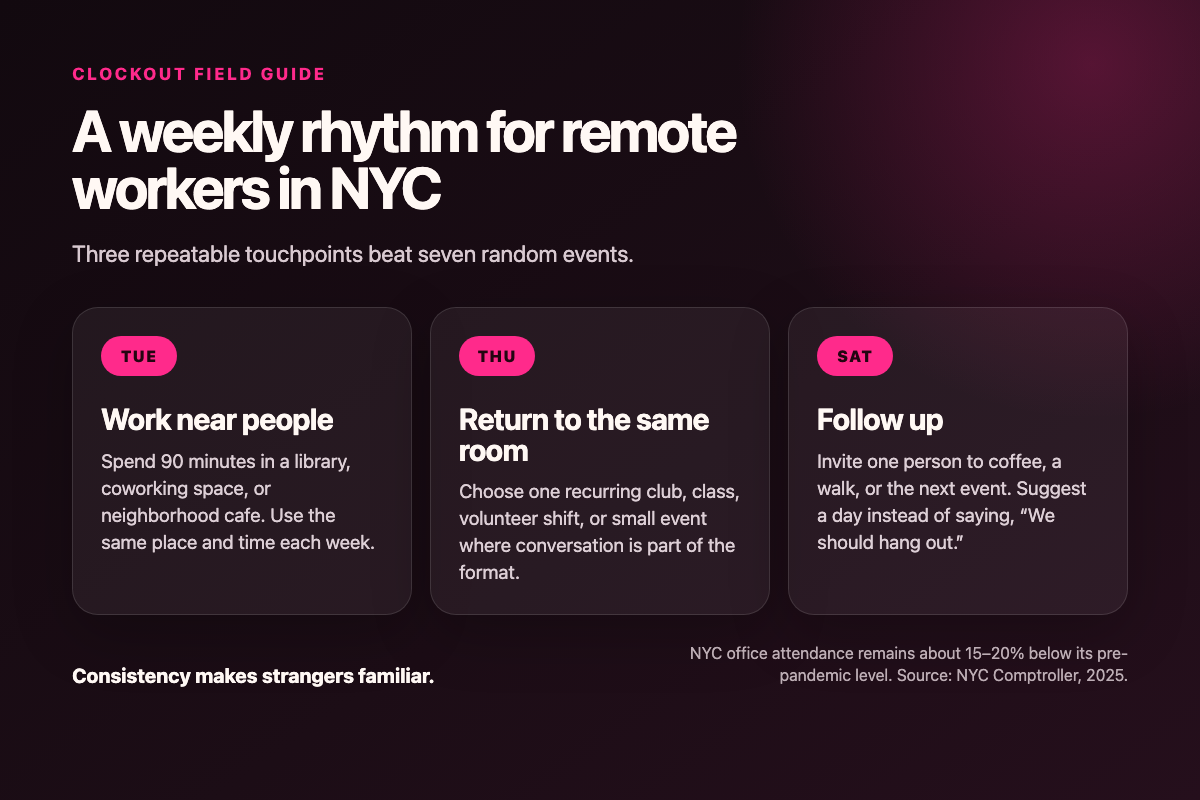
Tuesday: work near other people
Leave home for 90 minutes and work somewhere that allows light conversation. A neighborhood library, coworking space, or cafe can work. Go at the same time each week. Familiar staff and regulars make simple openings such as "Is this seat usually free around this time?" feel natural.
The goal is not to interrupt strangers who are concentrating. You are creating a place where small interactions can happen without planning an entire social night.
Thursday: return to the same room
Choose one recurring activity tied to something you already care about. It could be a professional club, a class, a volunteer shift, a run group, or a small event series. Check that it meets regularly and gives people a reason to talk.
Large lectures and crowded parties can be enjoyable, but they often end before you learn anyone’s name. Smaller formats with a shared activity usually make a second conversation easier.
Saturday: follow up with one person
Do not wait for a new friendship to organize itself. Send a short message within a day or two:
Good meeting you on Thursday. I’m going back next week. Want to grab coffee nearby beforehand?
Or:
You mentioned that gallery in Chelsea. I’m planning to go Saturday afternoon if you want to join.
A specific plan is kinder than "We should hang out sometime." It gives the other person something clear to accept, decline, or adjust.
Where to meet people when you work from home
The best place depends on the kind of connection you want. Look for formats that make return visits normal.
Neighborhood programs
The New York Public Library events calendar includes talks, workshops, book discussions, and classes across local branches. Filter by location and in-person events so the trip is easy enough to repeat.
NYC Parks also publishes an events calendar with fitness sessions, nature programs, arts activities, and seasonal events. A recurring activity in your borough is usually more sustainable than crossing the city for every plan.
Volunteer shifts
Volunteering solves the awkward first question because everyone already has a task. Look for a cause you would still care about even if you did not meet a close friend on the first day. Repeated shifts with the same organization give conversations time to develop.
Clubs and small events
Choose a group around an interest, profession, or activity rather than a room where the only shared goal is "meet people." The topic gives you something concrete to discuss and a reason to reconnect later.
Clockout lets members discover nearby people, join social clubs, and find local events in the app. Events and activity vary by city, so check what is currently available before making plans.
Classes and coworking sessions
A short course, studio class, or hosted coworking session gives the room a schedule. That structure is useful if open networking feels forced. Arrive ten minutes early, ask one person what brought them there, and stay for a few minutes after the session ends.
How to choose an event worth returning to
Before you RSVP, check five things:
| Question | What to look for |
|---|---|
| Does it repeat? | Weekly or monthly meetings give you another chance to talk. |
| Will people interact? | A class, discussion, shared meal, or group task is better than silent attendance. |
| Can you get there easily? | Pick somewhere close to home, work, or a direct train line. |
| Is the cost sustainable? | Make sure you can return without turning each visit into a major purchase. |
| What happens afterward? | A group chat, next date, or regular membership makes follow-up easier. |
Give a promising group two or three visits before deciding it is not for you. The first night is often spent learning the format. Familiarity starts to help on the second visit.
What to say when everyone seems busy
New Yorkers are often moving quickly, but that does not mean they are closed to conversation. Context matters. Ask about the thing you are both already doing:
- "Have you been to this group before?"
- "How did you hear about this event?"
- "I’m looking for a regular place to work outside my apartment. Have you tried this one on weekdays?"
- "Are you coming back next week?"
Listen for a detail you can return to. If someone mentions a neighborhood, project, class, or restaurant, ask one real follow-up question. That usually feels more natural than running through job titles.
How Clockout fits into the routine
Clockout is useful at the discovery stage. You can look for people nearby, clubs connected to your interests or industry, and local events where meeting in person is part of the plan. After an event, club conversations can provide a reason to stay in touch.
The app is free to download. Clockout also has optional Gold features and some paid event RSVPs. Applications are reviewed by the concierge team, and a friend invite may help you skip the waitlist. The membership FAQ explains the current process.
If you are starting from zero, choose one group you would be willing to attend again. A smaller repeatable plan is more useful than downloading five apps and waiting for something to happen.
Frequently asked questions
How can remote workers make friends in NYC?
Build repetition into the week. Work around other people at the same time and place, join one recurring activity, and follow up with one person after each visit. Familiarity makes conversation easier.
Do I need to pay for a coworking membership?
No. Libraries, cafes with appropriate seating, public programs, volunteer shifts, and community events can all create regular contact. If you use a cafe, buy something and avoid taking a table during the busiest hours.
What if I am introverted or dislike networking events?
Choose structured formats with a shared task. Classes, volunteer shifts, book discussions, and small clubs remove much of the pressure to introduce yourself without context.
How long does it take to build a social circle?
There is no reliable deadline. Judge the routine by whether you are seeing familiar faces and having easier second conversations. Keep the places that create repetition and replace the ones that do not.
Can Clockout help me meet people nearby?
Clockout is designed for local discovery, social clubs, and in-person events. Availability depends on your city and current activity in the app.
Start with one recurring room
You do not need a packed social calendar. Find one nearby group you would be happy to see again next week, then make one concrete follow-up plan.
Want an easier way to find your next group?
Clockout helps you discover nearby clubs, local events, and people who share your interests. Start with one group you would be happy to join again.
Find local clubs and events in Clockout
4.7 on the App Store, based on 7.8K ratings